Numbers Don't Lie

Friday, February 02, 2007

Americans don't save

In 2005, Americans saved -0.5% of their money in their banking accounts; in 2006, Americans saved -1.0 % of their money in banks. In previous years, the only time they saved less than that was 1933, with -1.5%. As you may know, America was in the Great Depression that year.
Source: heard from radio station wbbm780 , Feb 1st, 2007.

Labels:

Saturday, January 27, 2007

US household credit card debt

a)heard from the NPR radio (1/26/2007): the average US household now carry credit card debt of $7,753 , after many years of climbing of debt.

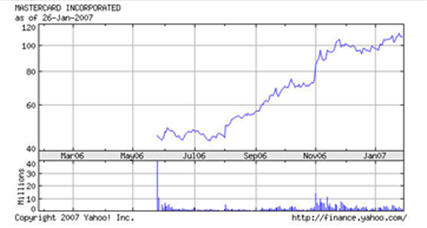
b)spot the stock price of Mastercard Inc. at Yahoo as of 1/26/2007:

Labels:

Wednesday, January 24, 2007

The cost of having kids

What is the take and give for having kids? If you think caring for children is taking years off of your life, you might be right! While researchers always assumed there was a human "fitness cost" for having kids—the price parents pay in their own health and longevity—a new study (which looked at 21,684 couples who lived in Salt Lake City and married between 1860 and 1895) actually quantifies this cost. Researchers found that a mother with 12 kids had a 5 times greater chance of dying prematurely than a mother of 3. And the toll on women was greater than that on men: Older mothers were 4 times as likely to die within a year of having a child than their male spouses were.

Labels:

Friday, January 19, 2007

A bipolar world

In Dec. 2006, the 5 brokerage firms in New York - Merrill Lynch, Morgan Stanley, Lehman brothers, Bear Sterns and Goldman Sachs - paid out $36 billion as bonus to their brokers. Their compensation and bonus together roughly are equal to Vietnam's GDP.
We are living in a bipolar world with huge wealth concentration.
Source: Barrons, Jan 15, 2007

Labels:

Sunday, December 31, 2006

I don't have anything to wear !

Oh, yeh? Many women are 'periodic excessive buyers', according to Jean Chatzky, the author of book Make Money, Not excuses. Although women's income are less then men, they spend more. In 2005, full-time full year female works earned 23% less than male workers, but single women spent $1,069 on clothing and services vs. $832 spent by single men. By some estimates, 12% -15% of American women are so called 'excessive buyers'.

Labels: ,

Monday, October 02, 2006

How much money to make you happy?

Who says money can’t buy you happiness? Economists Jonathan Gardner and Andrew Oswald report that winners of a medium-sized prize of between £1000 and £120,000 on Britain’s National Lottery subsequently enjoyed a significant improvement in their psychological well-being compared with others who had only a small win, or no win at all. The difference, in their measurement, is positive 1.4 point. For the reference, being widowed was associated with an average drop in well-being of 5 points. Researcher conclude the 1.4 point positive change enjoyed by medium-sized winners was economically significant and not merely statistically significant.

Labels: , ,

Thursday, September 07, 2006

Tall people earn more

It is been know for some time that tall people earn more, each additional inch of height adds roughly 2% to average annual earnings, for both men and women. In a new study, two scientists from Princeton University, find that tall people earn more, because they're smarter, on average. It is possible that early childhood care, including prenatal care, can increase both height and cognitive ability.

Labels: , , ,

Saturday, August 26, 2006

Where have America's money gone to ?

1) over last 35 years, the rise in wages and salaries in the wide middle of the income distributions was 11%. The rise in wages and salaries at the top 0.01% of the income distribution was 617%.
2) between 1966 - 2001, only 10% of America workers saw their income rise at least as fast as economy-wide productivity did.
3) from 1997 - 2001, the top 1% of people captured far more of the real national gain in wages and salary income than did the bottom 50%.
Source: The Atlantic, Sept. 2006.

Labels:

Thursday, August 24, 2006

Women are still uncertain about their financial futures

Although increasing number of women are controlling more money, running countries and companies, and taking care of their family, still 90% of the 1,925 women surveyed said they feel financially insecure, according to a study about women and money released by Allianz Life Insurance Co.
Why the fear? Women have longer life expectancies, but typically earn less than men. Some spend years out of the work force raising children, to name few reasons.

Labels: ,

Wednesday, August 09, 2006

Economical numbers

"There are 10^11 stars in the galaxy. That used to be a huge number. But it's only a hundred billion. It's less than the national deficit! We used to call them astronomical numbers. Now we should call them economical numbers".
-Richard Feynman, physicist, Nobel laureate (1918-1988).
Source

Labels:

Friday, August 04, 2006

Can money buy happiness ?

A survey conducted earlier this year by the Pew Research Center reports that 49% of respondents with an annual family income above $100,000 say they are very happy. When income falls between $75,000 and $100,000, the very-happy contingent falls to 38%. Just 24% of those with incomes below $30,000 said they were very happy.

Labels:

Monday, May 01, 2006

A credit card nation

Last year in US, credit card companies spent $6 billion dollars to promote their credit cards services, a 16% increase from the previous year. Each month, an average adult received 6 unsolicited credit card application forms, and 0.3% of people do apply for them.
Heard from CBSnews, April 30th, 2006.

Labels: ,

Saturday, April 22, 2006

The oil and us

Nearly 88% of Americans drive to work each day, with an average round-trip taking 52 minutes. No wonder United States is the world's largest user of petroleum, consumes about 20 million barrels a day.

Labels: ,

Monday, April 17, 2006

How we prepare taxes ?

In US, here is how people likely to prepare for their 2005 federal income taxes:
1) 60% people use professional helps, like H&R Block;
2) 20% people use software such as Turbo Tax;
3) 20% people still use pencil & paper.
80% of Americans think the tax code is too complex. More people complained about the complexity of doing their taxes than about how much they had to pay.

Labels: ,

Saturday, April 08, 2006

U.S. national debt

Where are you in the struggle to balance your checkbooks every month?
According to the U.S. national debt clock, US national debt has continued to increase an average of $2.44 billion per day since September 30, 2005; and each US citizen's share of this debt is $28,083.56, as of today.

Labels: ,

Knowledge is money

There were 2,974 patents awarded to IBM in 2005, the most to any company. IBM's worldwide active patent portfolio now exceeds 40,000. The compnay earned $948 million last year off its global patent portfolio licensing, alone.

Labels: ,

Thursday, March 30, 2006

How to become a millionaire ?

In US, households with a net worth of at least $1 million, excluding primary residences, rose 8% to a record high 8.9 million, according to a recent survey. How to get this rich ? Old tricks:
1) 46% of those surveyed own investment real estate, like a second home or rental properties;
2) 70% owned stocks and bonds, and 68% owned mutual funds;
3) 19% owned in whole or part a professional practice or privately held business;
4) median age of the head of millionaire households is 58, and 45% are retired - wealth is the result of long-term wealth accumulation.

Labels:

Tuesday, March 28, 2006

It is deadly to be lonely

A new study has found that loneliness in people over 50 increases their risk of high blood pressure. The loneliest people studied had blood pressure readings as much as 30 points higher than those who weren't lonely. This suggests loneliness can be as bad for the heart as being overweight or inactive.
-
Source: Psychology and Aging, March, 2006.

Labels:

Monday, March 27, 2006

Heavy smokers likely to be impotent

Smoking may increase a man's risk of impotence by almost 40%, The correlation shows up in men who smoke more than a pack a day. Smoking up to 20 cigarettes a day correlated with a 24% increase in impotence. Data can be explained by nicotine and other related chemicals diminishing blood flow to the penis and blood pressure in it. However here is the good finding: moderate alcohol consumption significantly reduced the risk of impotence.

Source : Tobacco Control

Labels:

Wednesday, March 22, 2006

Where did the money go ?

The US economy has been growing since 2001, but all the benefits of that growth have gone into corporate profits instead of employees. In 2005, more than 80% of American workers saw their inflation-adjusted wages fall for the second year in a row.

Since 1990, while median family income has risen 5.8%, the cost of a bachelor’s degree jumped 63% at public colleges and 47% at private colleges. Health-insurance premiums rose 9.2% in 2005, more than 2.5 times the inflation rate.

Labels: